Trading Tips
Gold as an Inflation Hedge: Why XAUUSD Rises When Prices Rise
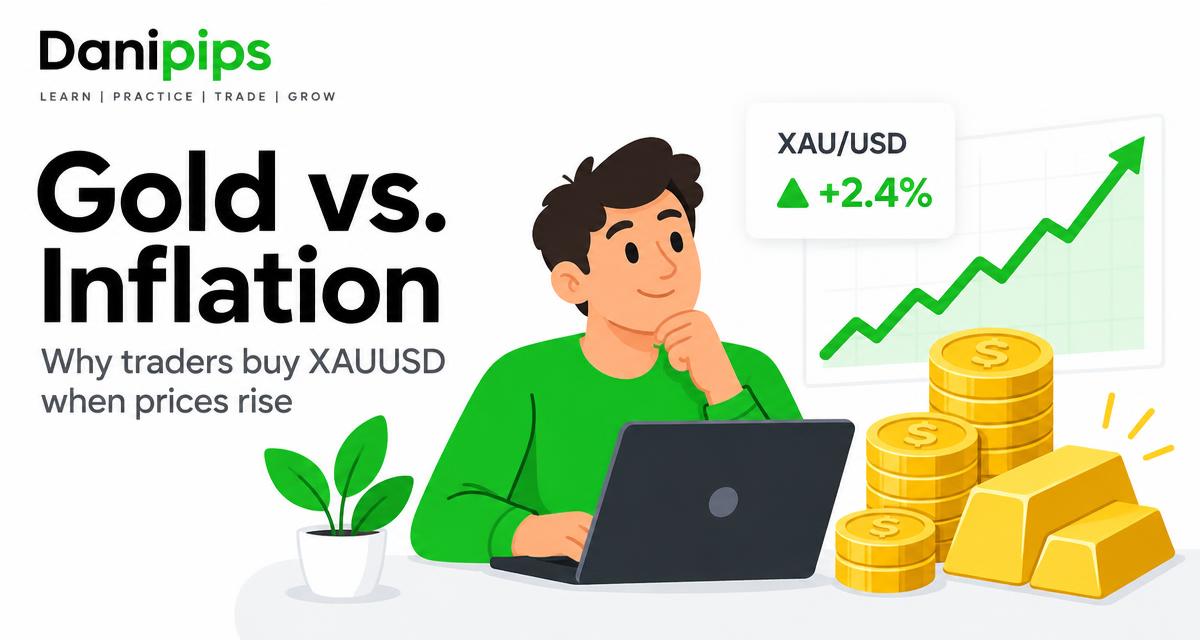
The problem: your money quietly shrinks
If a basket of groceries costs noticeably more this year than it did last year, you are watching inflation at work. Inflation means the general level of prices rises over time, so every unit of money you hold buys a little less than it did before. Your salary may stay the same, but the real value of it shrinks.
For more than a century, investors have turned to one asset in particular when they worry about this: gold. You will hear it called a "store of value" or an "inflation hedge" on almost every financial news channel. But what does that actually mean, why do traders connect it with the XAUUSD chart, and does it always work? This guide explains it in plain language, then looks at what it means for you as a beginner trader.
What inflation actually is
Inflation is the rate at which prices for goods and services rise across an economy. Governments measure it with indexes such as the Consumer Price Index (CPI), which tracks the cost of a typical basket of items: food, housing, fuel, transport and so on.
When CPI comes out each month, markets react quickly, because inflation data changes what people expect central banks to do next. (We covered how to trade around these releases in our guide to NFP, CPI and Fed decisions.)
A useful way to picture inflation: at 5% annual inflation, roughly the same money buys about 5% fewer things each year. Compounded over a decade, that quietly adds up to a serious loss of purchasing power.
Why gold is considered an inflation hedge
The idea behind gold as a hedge rests on three properties:
- Limited supply. Gold cannot be printed. New supply only comes from slow, expensive mining. When more paper money circulates, the amount of gold in the world barely changes.
- It does not "earn" anything. A bond pays interest, a company pays dividends. Gold just sits there. That sounds like a weakness, and in normal times it is. But it means gold's price is not tied to any company's earnings or any government's promise to repay.
- Universal recognition. A kilogram of gold is accepted anywhere in the world, in any currency zone. That makes it a neutral reserve asset that central banks themselves hold.
When people lose confidence that paper money will hold its value — usually because inflation is high or rising — demand for gold tends to increase. Higher demand, with almost fixed supply, pushes the price up. That is the hedge in action.
How this shows up on the XAUUSD chart
On your trading platform, gold is quoted as XAUUSD — the price of one troy ounce of gold in US dollars. When you hear "gold is at a record high", that chart is what they mean.
Inflation connects to XAUUSD through a chain of cause and effect:
- Inflation comes in hotter than expected.
- Investors expect the central bank to respond, usually through interest-rate decisions.
- Real interest rates (interest minus inflation) matter most. When inflation is higher than the interest you can earn on cash and bonds, holding gold costs you less in "missed" income — so it becomes relatively more attractive.
- The value of the US dollar also matters, because gold is priced in dollars. A weaker dollar tends to support gold, and a very strong dollar tends to weigh on it.
None of this is mechanical. Several forces push on gold at the same time — geopolitics, central bank buying, investor sentiment — and the strongest one at any moment decides the direction.
The honest caveat: gold is not a guaranteed hedge
Here is what most headlines leave out: gold does not always rise when inflation rises.
In the early 1980s, inflation in the US was high — and gold fell sharply for years, because interest rates rose even faster. In 2022, inflation hit multi-decade highs, and gold still spent much of the year under pressure because aggressive rate hikes made holding an asset that pays nothing expensive.
So a more accurate statement is: over very long periods, gold has preserved purchasing power. Over short periods — weeks and months, the timescales a retail trader actually works with — it can move violently in either direction. Gold regularly swings 2–3% in a single day, and even more around major news.
That distinction matters. Gold is a hedge for a savings horizon measured in years. A trade on XAUUSD is measured in hours or days, and in that timeframe it is simply a volatile, trending instrument — one that deserves respect.
What this means for you as a beginner trader
If your goal is to trade gold rather than to store wealth in it, treat XAUUSD as what it is on the chart: a fast, high-range market. A few practical points:
- Gold moves differently from forex pairs. Ranges are wider and moves are sharper. We explain the specifics in Gold Trading Basics: Why XAUUSD Moves Differently Than Forex Pairs.
- Lot size arithmetic is unforgiving. One standard lot of gold is 100 ounces, so every $1 of price movement moves your position by $100. Before you place any trade, run the numbers with our step-by-step gold lot size guide.
- The most common way beginners lose on gold is oversized positions. These five gold trading mistakes cover exactly what to avoid.
- Follow live prices and the day's range on our XAUUSD instrument page before you commit to a direction.
Managing risk when trading gold
Because gold's daily range is large, position sizing is the whole game. The rule we teach everywhere applies doubly here: risk no more than 1% of your account on a single trade. Our Risk Management 101 guide walks through the reasoning, and the position size calculator converts your stop-loss distance into an exact lot size in seconds.
Set the stop-loss before you enter, not after. Gold can move $10–$20 against you during a strong session without pausing, and "it will come back" is not a plan.
Practice before you risk money
Everything in this article can be tested without spending a cent. Open a demo account, pull up XAUUSD, and watch how it behaves during a CPI release or a Fed decision. Notice how much faster it moves than EURUSD.
If you want structured lessons, our free forex course takes you from your first chart to your first managed trade in simple steps. The commodities module of the trading tips section is also worth a read before you specialize in metals.
Choosing a broker for gold trading
Gold is a spread-and-cost-sensitive market, so where you trade matters almost as much as how. We use and review Exness in detail on our Exness review page: low minimum deposits, demo accounts, and stable pricing on metals are the practical reasons it suits beginners.
If you want to open an account, you can use our referral link:
We may earn a referral commission at no extra cost to you. It never changes what we write — test on a demo first and only trade money you can afford to lose.
Key takeaways
- Inflation slowly erodes the purchasing power of money; it is measured by indexes like CPI.
- Gold is called an inflation hedge because of its limited supply and its independence from any company or government.
- The link works through real interest rates and the US dollar — not mechanically, and not on any fixed schedule.
- Over decades gold has preserved value; over days and weeks it is simply a volatile instrument that punishes oversized positions.
- For a trader, that means strict position sizing, a stop-loss set before entry, and demo practice before live money.
Want practical trading notes like this in your feed? Join our Telegram channel for daily posts.