Trading Tips
What Is a Pip? The Smallest Unit of Profit in Forex, Explained
Everywhere in forex, prices seem to move by tiny amounts — but how do traders describe those moves without getting lost in decimals? The answer is the pip, the standard unit of measurement in currency trading. If you understand what a pip is, you can measure price movement, set stop losses, count your profit, and compare trades across different currency pairs — all in one simple language.
What exactly is a pip?
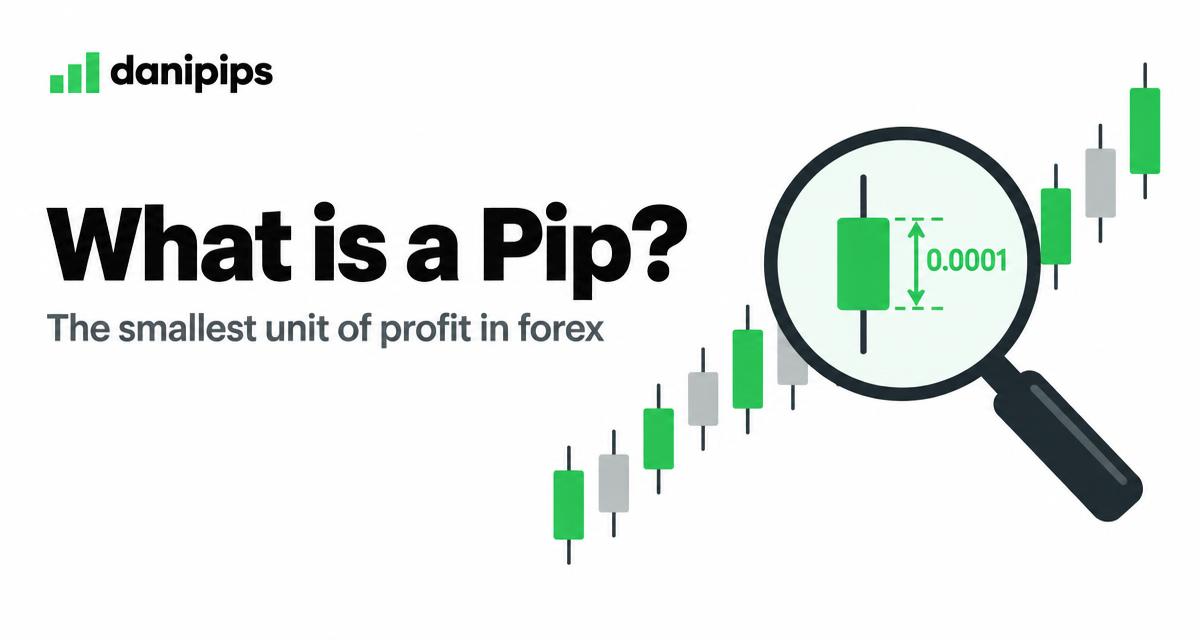
The word pip stands for "percentage in point" (or "price interest point"). It is the smallest common change in the price of a currency pair.
Most major currency pairs are quoted to four decimal places. For those pairs, one pip is a movement of 0.0001 in the price.
Example:
- EUR/USD is quoted at 1.1050
- A few minutes later it is at 1.1058
- The price has moved 8 pips
That is the whole idea. Traders say "8 pips" instead of "0.0008" because it is faster, clearer, and works the same way on every major pair.
If EUR/USD later moves from 1.1058 back down to 1.1050, it has fallen by 8 pips. The direction changes the meaning, but the counting stays the same.
Pips and "pipettes"
Modern trading platforms usually show prices with a fifth decimal, for example 1.10503. That extra digit is called a pipette (or fractional pip) and it is worth one-tenth of a pip.
So in 1.10503:
- The pip digit is the fourth decimal — the 0
- The pipette is the fifth decimal — the 3
Do not let it confuse you. Most traders still plan their trades in whole pips; the pipette only matters for very precise entries and for measuring spreads.
Pips on Japanese yen pairs
There is one important exception: currency pairs that include the Japanese yen (JPY) are quoted to only two decimal places. For those pairs, one pip is a movement of 0.01.
Example:
- USD/JPY is quoted at 150.00
- It rises to 150.15
- That is a move of 15 pips
So the rule is simple: four decimal places on most pairs, two decimal places on JPY pairs. Either way, "one pip" means the smallest step that matters in day-to-day trading.
How much money is one pip worth?
This is where pips become practical. The value of one pip depends on two things: which pair you are trading and what lot size you are using.
On pairs where the US dollar is the second currency (like EUR/USD or GBP/USD), one pip is worth approximately:
- Standard lot (1.00) = 100,000 units → about $10 per pip
- Mini lot (0.10) = 10,000 units → about $1 per pip
- Micro lot (0.01) = 1,000 units → about $0.10 per pip
So if you buy EUR/USD with a mini lot and the price moves 8 pips in your favor, your profit is roughly 8 × $1 = $8. If it moves 8 pips against you, your loss is about the same.
Two honest notes:
- When the US dollar is not the second currency (for example on USD/JPY or cross pairs like GBP/JPY), the pip value in dollars is different. Your trading platform calculates it automatically — you just need to know it is not always $10.
- If your account is in a different currency (naira, shillings, dirhams, birr and so on), the platform converts the pip value for you.
The real skill is turning pips into position size: how many lots can you trade so that your stop, measured in pips, equals a loss you can accept? That is exactly what our guide on Pips, Lots, and Position Sizing walks through step by step.
Pips on gold (XAUUSD)
Gold is quoted differently from currency pairs, and its "pip" convention varies between platforms. On XAUUSD, many traders simply talk about how many dollars the price moved — for example, "gold moved $5 today" — because that is how the market actually behaves. Other platforms define a pip as 0.10 of the price.
The safe approach: before you trade gold, open your platform and check the contract specifications for XAUUSD so you know exactly how your platform counts pips, and always plan your gold risk in dollar terms. Our step-by-step guide on How to Calculate Lot Size on Gold covers this in detail.
Why pips matter: stops, targets, and risk
Pips are how traders express their plan:
- "My stop loss is 20 pips below my entry."
- "My target is 40 pips above my entry."
That trade has a 1:2 risk-to-reward ratio — you risk 20 pips to make 40. If you risk the same pips on every trade and keep your reward bigger than your risk, you can be wrong more often than you are right and still come out ahead.
Then pips connect to money: a 20-pip stop on a mini lot is roughly $20 of risk; on a standard lot it is roughly $200. This is why position sizing — not prediction — is what keeps a small account alive. The 1% Rule is the classic way to apply this.
Spreads are also counted in pips
The spread — the small gap between the buy and sell price — is measured in pips too. If EUR/USD shows a bid of 1.1050 and an ask of 1.1051, the spread is 1 pip, and your trade starts 1 pip in the red. During big news events spreads can widen to several pips for a short time.
This is why pip counting matters when you choose a broker: a broker whose typical spread on EUR/USD is 0.1–1 pip gives every trade a cheaper start than one quoting 2–3 pips. You can read more in Forex Spreads Explained.
Common beginner mistakes with pips
- Confusing pips with cents or points. A pip is a fixed unit (0.0001 on most pairs, 0.01 on JPY pairs), not "whatever the last decimal is."
- Planning stops in dollars instead of pips. Dollar stops depend on your lot size; pip stops describe the distance the trade needs. Combine both with proper position sizing.
- Ignoring pip value differences between pairs. 20 pips on EUR/USD is not the same dollar value as 20 pips on GBP/JPY.
- Treating gold like a currency pair. Gold moves in dollars, and its pip convention depends on the platform.
Practice counting before you risk anything
You do not need to memorize any of this — you need to use it. Open a demo account, place a few trades, and watch how the profit and loss numbers move with each pip. Within an afternoon, "20 pips" will stop being math and start being something you can feel.
When you are ready to move from demo to live, pick a broker with tight spreads and reliable execution. We recommend Exness for beginners in Africa, Asia and the Middle East — you can read our full Exness review or open your account here.
One pip is a small thing. But learning to count in pips is the moment trading stops being guessing and starts being a plan.