Trading Tips
Forex Slippage Explained for Beginners: Why Your Trade Opens at a Different Price
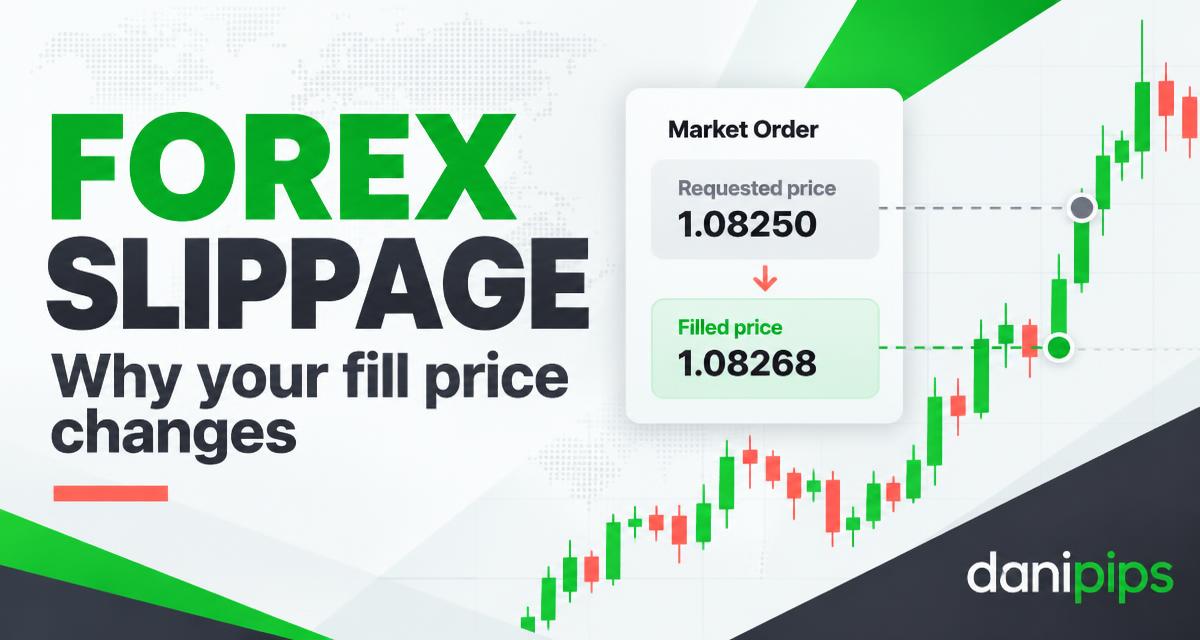
You tap Buy on EURUSD at 1.08250, but your platform shows an entry at 1.08268. Did you make a mistake? Not necessarily. The difference may be slippage: your order was executed at a different price from the price you expected.
Slippage is an important beginner topic because a trading plan is only an estimate until an order actually fills. It can change your entry cost, your effective stop distance, and your final loss. Understanding it helps you review trades more accurately without assuming that every unexpected fill is a scam.
This guide explains slippage using fictional examples, distinguishes it from spread, and shows how to manage the risk without pretending that any broker or strategy can eliminate it.
What is slippage in forex?
Slippage is the difference between an expected execution price and the actual price at which an order fills. It can affect entries and exits, including orders triggered by a stop loss.
For a buy order, a higher fill price is worse for you and a lower fill price is better. For a sell order, a lower fill price is worse and a higher fill price is better. The direction matters: a price increase is not automatically negative slippage for every order.
Negative slippage means your execution is less favorable than expected. Positive slippage means the execution is more favorable. Whether positive slippage is passed on, and how orders are handled, depends on the broker's execution policy and the particular product.
A quoted price is not a promise that unlimited volume is available at that level. While an order travels to the execution system, prices and available liquidity can change. The exact mechanics vary by broker, account type, platform, and instrument.
A simple EURUSD slippage example
Imagine you submit a market buy for 0.02 standard lots of EURUSD when the displayed ask price is 1.08250. The order fills at 1.08268.
The difference is:
- Actual fill minus expected price: 1.08268 − 1.08250 = 0.00018.
- For EURUSD, one pip is normally 0.00010.
- Your entry slippage is therefore 1.8 pips worse than expected.
With a standard EURUSD contract of 100,000 units, 0.02 lots equals 2,000 euros. In a USD-denominated account, its pip value is approximately $0.20 per pip. The 1.8-pip price difference represents approximately $0.36 of additional entry cost relative to the expected fill, before any separate commission.
That amount may look small. However, frequent trades, larger positions, or wider execution differences can make the total material. Always check your instrument's actual contract specification; the same pip-value assumption should not be carried over to gold, oil, or every currency pair.
Slippage versus spread: what is the difference?
Spread is the difference between the bid and ask prices at a particular moment. Slippage is the difference between your expected execution price and your actual fill.
Suppose EURUSD is quoted at bid 1.08240 and ask 1.08250. The spread is one pip. A market buy normally starts from the ask side, not the bid. If you compare your buy fill with the bid displayed on a chart, you may mistakenly call the spread slippage.
Now suppose the buy fills at 1.08268 instead of the expected ask of 1.08250. That additional 1.8-pip difference is the slippage in this example.
When checking an execution, compare like with like: buy entry against the relevant ask, sell entry against the relevant bid, using the closest available timestamps. Chart prices alone may not provide the full evidence. A commission is a separate charge and should not be confused with either spread or slippage.
Why slippage happens
1. Prices move quickly during major news
Interest-rate announcements, US inflation releases, and employment reports can cause rapid price changes. There may be fewer available quotes near your expected price, or liquidity may disappear while participants reassess the news.
A correct prediction of the news direction does not guarantee a good fill. For a beginner, standing aside can be a valid risk decision. Review the Danipips economic calendar before planning an entry.
2. Available liquidity is limited
Your entire order may not be executable at one price. Larger orders can require fills across several price levels. Retail CFD execution differs across providers, so do not assume that every broker uses the same mechanism.
3. Markets reopen after a gap
A market can reopen beyond the price where you placed a stop. This can happen after a weekend or a trading interruption. A standard stop loss generally cannot create liquidity at a price the market skipped.
4. Delays can widen the difference
Network delays, platform processing, and execution-system latency can contribute to a different fill. A faster connection may help reduce some delay, but it cannot prevent market gaps or guarantee a particular execution price.
Can a stop loss slip?
Yes. A standard stop loss sets a trigger level; it is not necessarily a guaranteed exit price. Once triggered, the order is handled according to the broker's rules and may execute at the next available price.
Consider a USD account with $500, a EURUSD buy at 1.08250, and a stop at 1.08000. The planned stop distance is 25 pips. At 0.02 lots and approximately $0.20 per pip, the planned price-based loss is $5, or 1% of the starting account balance, excluding commission and other costs.
If the triggered stop fills at 1.07980, the actual distance from entry is 27 pips. The price-based loss becomes approximately $5.40, before separate costs. That is $0.40 more than the planned amount.
This is an illustration, not a recommendation to risk 1% on every trade. It shows why a position-size calculation is a planning tool rather than a guarantee of maximum loss. Extreme gaps can produce much larger differences.
Do limit orders solve the problem?
A limit order generally asks for execution at your chosen price or better, under the product's order rules. A buy limit specifies a maximum purchase price; a sell limit specifies a minimum sale price.
The trade-off is non-execution. Price can approach your level without sufficient executable liquidity, and your order may remain unfilled. Some systems also allow partial fills. Confirm how your platform and account handle these situations.
A stop-limit order, where available, adds a price limit after a stop trigger. That can constrain an unfavorable fill, but it can also leave you in an open position while price keeps moving. It should not be treated as a guaranteed protective exit.
Choose an order type that fits your plan. Do not switch to unfamiliar order settings immediately before important news.
Practical ways beginners can manage slippage risk
- Check upcoming events. Decide in advance whether your strategy permits entries or open positions around major releases.
- Use modest position sizes. Larger positions magnify the money impact of an execution difference.
- Understand market and limit orders. Know what each order prioritizes: execution or price conditions.
- Review trading hours. Market openings, rollover periods, and low-liquidity conditions can behave differently from active sessions.
- Read contract and execution details. Check the instrument's lot size, price increments, stop rules, trading breaks, and applicable charges.
- Keep an execution record. Save requested price, actual fill, order type, volume, time, and relevant news. This is more useful than judging from memory.
- Leave room for uncertainty. A risk limit should account for costs and the possibility of an exit beyond the intended stop.
These habits manage exposure; they do not eliminate slippage or make leveraged trading safe.
A five-minute demo practice exercise
Use a demo account to learn your platform's order ticket without risking real funds:
- Choose one instrument and read its contract specification.
- Record the bid, ask, and spread before placing a small fictional order.
- Submit a market order and write down the actual fill.
- Place a limit order elsewhere and observe whether it fills or stays pending.
- Record how you set and modify a stop loss, then review the resulting history.
Do not seek volatile news conditions just to generate dramatic results. Demo execution may differ from live execution, so this exercise teaches mechanics rather than predicting your future fills.
If you need setup help, read How to Open a Free Exness Demo Account. You can also visit Exness through Danipips' referral link. Availability, account terms, and protections depend on your country and the entity serving you.
Affiliate disclosure: Danipips may earn a referral commission if you join through this link. A referral relationship does not guarantee execution quality or trading results.
Is slippage proof of broker manipulation?
No. Slippage alone does not establish misconduct. Fast markets, price gaps, liquidity changes, and order rules can explain a different fill.
However, repeated unexplained differences deserve investigation. Save the order ID, timestamps, requested price, fill price, and any available bid/ask evidence. Ask the broker for its execution explanation and compare it with the written policy. If the response remains unsatisfactory, check the complaint process of the legal entity serving your account and its relevant regulator.
Avoid accusations based only on a chart screenshot or one losing trade. Equally, do not dismiss a documented pattern without asking questions.
Frequently asked questions
Can slippage happen on a small account?
Yes. Account size does not prevent price changes. The financial impact depends on position size and the difference between expected and actual execution.
Does every trade experience slippage?
No. Some orders fill at the expected price, some more favorably, and some less favorably. Execution conditions vary.
Can a broker promise zero slippage?
Treat broad guarantees cautiously. Read the specific execution terms rather than relying on a slogan. Any guaranteed-stop feature, if offered, can have restrictions and costs.
Is positive slippage a trading strategy?
No. A favorable fill is not a dependable source of profit. Build your plan around risk control and repeatable decisions, not occasional execution improvements.
The takeaway
Slippage is a difference between expectation and execution. It is not the same as spread, and a normal stop loss may not cap your loss at an exact price. Compare the correct bid or ask, understand your order types, size conservatively, and record fills so you can evaluate what actually happened.
Start with platform practice and a clear plan. Forex and CFD trading involve substantial risk; you can lose money, and protections vary by jurisdiction. This article is educational information, not personal investment advice.