Trading Tips
Forex Trading Journal for Beginners: A Simple Template to Review Every Trade
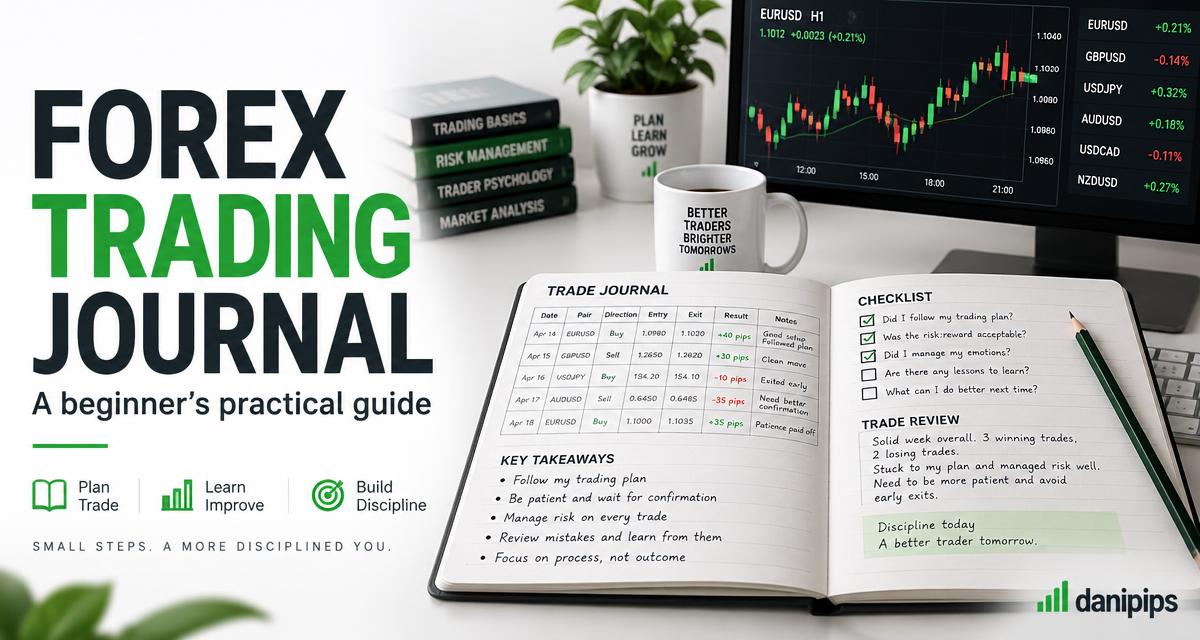
A trading platform tells you where an order opened and closed. It does not tell you why you entered, whether you followed your rules, or what you should change next time. That is the job of a trading journal.
For beginners, the biggest benefit is not a beautiful spreadsheet. It is separating a profitable trade from a well-executed trade. You can make money after breaking every rule, or lose money after following a sensible plan. A journal helps you spot the difference before luck becomes a habit.
This guide gives you a simple template, a fictional EURUSD example and a weekly review routine. It is educational material, not a promise of profitable trading.
What is a forex trading journal?
A forex trading journal is a record of your decisions before, during and after each trade. It combines platform facts—entry price, position size, exit and costs—with your reason for entering and your assessment of the process.
A notebook, spreadsheet or private document can all work. Start with something easy enough to update consistently. Avoid adding twenty indicators or complicated ratings before you can reliably record the basics.
Your first goal is to answer three questions:
- What did I plan to do?
- What actually happened?
- Did I follow my plan?
A journal does not turn a weak strategy into a strong one. It creates evidence you can use to evaluate and improve your decisions.
What should beginners record?
1. Trade identity and market conditions
Record the date, time, time zone, instrument and direction. Include the chart timeframe and whether important economic news was nearby. "Tuesday morning" is too vague; "Tuesday, 09:15 UTC, EURUSD, 15-minute chart" makes comparisons possible.
Keep your time zone consistent. If you are in Dubai, record either local time with UTC+4 noted or use UTC throughout. Do not mix broker-server time and local time without labeling them.
2. Your entry reason
Write a specific observation rather than "it looked bullish." For example: "Price returned to a previously marked support area, formed a higher low and closed above the previous candle's high."
This is a description of a hypothetical setup, not a recommended signal. Record the actual conditions your own plan requires, including any reason you should stay out.
3. Planned risk and position size
Write down your account balance, intended risk in money, lot size, entry and initial stop loss before placing the order. Record the take-profit level if your plan uses one.
Your chosen risk amount is a planning target, not an absolute loss guarantee. Slippage, gaps and trading costs can produce a larger loss than you expected.
Use the Danipips calculators and verify the instrument's contract specifications with your platform. Do not copy a EURUSD pip-value assumption into gold or crypto trades.
4. Actual execution and net result
Record the actual fill, exit, commissions, swap and net profit or loss. Spread is already reflected in bid/ask execution and trade P&L; do not subtract it a second time if the platform result already includes it.
Use platform statements to check your numbers. If you entered at a different price from your plan, record the difference rather than rewriting the original plan after the event.
5. Process and emotions
A short note is enough: "Calm before entry; tempted to move the stop after the first pullback; left it unchanged." Record actions, not just feelings.
Keep one simple process label: followed plan, minor deviation or major deviation. Define those labels in advance. Moving a stop to increase exposure after entry is different from accidentally recording the wrong time.
Copyable beginner trading-journal template
Copy this section into a notebook or spreadsheet:
``text``
Trade ID:
Date and time, including time zone:
Instrument / direction / timeframe:
Market condition and nearby news:
Setup and entry reason:
Account balance before trade:
Planned entry / initial stop / target:
Planned risk in money:
Position size and contract assumptions:
Actual entry / exit:
Commission / swap:
Net profit or loss:
Net result in R:
Before-and-after screenshot references:
Did I follow my plan?
What did I do well?
One specific improvement:
Never put your broker password, account recovery codes or identity documents in your journal. If you share a screenshot, hide account numbers and personal information first.
Worked example: journaling a EURUSD trade
Imagine a fictional USD-denominated demo account with a $500 balance. The trader chooses a $5 planned price risk, equal to 1% of that balance. This is an illustration, not a risk recommendation for every reader.
The planned trade is:
- Buy EURUSD at 1.08000.
- Initial stop at 1.07750: 25 pips below entry.
- Target at 1.08500: 50 pips above entry.
- Position size: 0.02 standard lots.
Assuming a standard lot represents 100,000 EUR and a pip is 0.0001, the position is 2,000 EUR. Its pip value in a USD account is $0.20. Therefore, 25 pips × $0.20 gives $5 of planned price risk, excluding additional charges and adverse execution.
Suppose the entry fills as planned, and the trader closes at 1.08300. That is a 30-pip gain, or $6 gross. If total commission is $0.40 and swap is zero, the net result is $5.60.
The trader writes:
Entered after my defined support setup appeared. Closed before the target because I felt nervous, although my exit rule had not triggered. Net result: +$5.60. Process: minor deviation. Improvement: follow the prewritten exit rule in the next demo session rather than responding to P&L fluctuations.
The trade made money, but the journal identifies an unplanned action. That is more useful than simply writing "good trade."
If an early exit was allowed by the original plan, it would not automatically count as a deviation. Judge the action against the rule you actually set before entry.
What does “R” mean in a journal?
One R represents the initial planned monetary risk you use as the denominator. State whether that denominator includes estimated costs, and keep the convention consistent.
Using $5 of planned price risk in the example:
Net result in R = net profit or loss ÷ initial planned risk.
$5.60 ÷ $5 = +1.12R.
If another trade produces a $5.50 net loss against the same $5 planned risk, the result is −1.10R. Losses can exceed −1R because of costs, gaps or slippage. Do not force the number back to −1R to make a spreadsheet look tidy.
R helps compare trades with different position sizes. It does not prove a strategy works, and results depend on consistent definitions and complete records.
A ten-minute weekly review
Review your journal at a fixed time, away from an open trade.
Step 1: Check completeness
Match your recorded trades to the platform statement. Include losing trades and impulsive trades; leaving them out makes the analysis misleading. Mark missing details as unknown rather than inventing them.
Step 2: Separate outcome from behavior
Group trades into those that followed the plan and those that did not. Look for repeated behaviors: trading during news despite a no-news rule, increasing size after a loss or entering before confirmation.
Do not judge a strategy from two wins or three losses. Small samples are noisy, and several trades in the same market move may not be independent evidence.
Step 3: Review costs and execution
Look at net results, not only gross gains. Note whether wider spreads, overnight swap or adverse fills repeatedly affected a particular trading time or instrument.
A different fill alone does not prove broker misconduct. Preserve timestamps and platform records if you need to investigate execution.
Step 4: Choose one adjustment
Pick a measurable action, such as "write the stop and position size before every demo entry." Changing the strategy, timeframe, instrument and risk all at once makes it hard to identify what helped.
Write the adjustment at the top of next week's journal. Review whether you followed it before deciding whether it was useful.
Record decisions not to trade
A no-trade entry can be valuable. For example:
EURUSD, 12:20 UTC. Price reached my area, but an important scheduled release was close. My plan excludes entries around that event, so I stayed out.
The next price move does not determine whether staying out was correct. The important question is whether the decision matched your prewritten rules. This builds consistency without rewarding you for taking every possible opportunity.
Check the economic calendar before your session and confirm the displayed time zone.
Common journaling mistakes
- Recording only winners: creates a flattering but unreliable picture.
- Changing the entry reason afterward: hides the decision you actually made.
- Collecting screenshots without notes: preserves pictures but not your reasoning.
- Writing “be disciplined” as the only lesson: replace it with a specific action.
- Treating demo results as a live-profit forecast: demo execution and emotional pressure may differ from live trading.
- Overcomplicating the template: a short journal completed consistently beats a detailed one abandoned after a week.
Practice before risking real money
If you do not yet have a repeatable method, begin with the Danipips Academy and journal demo trades while learning order types and risk management.
You can also follow our free Exness demo-account guide. If Exness is available and appropriate in your jurisdiction, you can explore Exness through our referral link.
Referral disclosure: Danipips may earn a referral commission if you register through this link. Availability, legal protections and account conditions depend on your country and the entity serving you. A demo account does not guarantee comparable live execution or future profits.
Frequently asked questions
Do I need paid journaling software?
No. A notebook or spreadsheet is sufficient for learning. Choose paid tools only if their features solve a problem you actually have, and review how they handle your account data.
How many trades should I record?
Record every trade. There is no universal number that proves a strategy is profitable. Longer records across different conditions provide more context, but historical results still do not guarantee future outcomes.
Should I record emotions?
Yes, briefly and specifically. "Wanted to recover yesterday's loss and doubled size" is more useful than "felt bad." Connect the emotion to the action so you can review it.
Does keeping a journal prevent losses?
No. It helps you document behavior, review risk and identify patterns. Losing trades remain possible even when you follow a carefully written plan.
The takeaway
A useful trading journal is an honest record, not a scoreboard. Capture the plan before entry, use actual fills and net results afterward, and review one specific behavior each week. Start simple, practice on demo and focus on decisions you can control rather than promising yourself a particular profit.
Risk warning: Forex and leveraged CFDs involve substantial risk. You can lose money quickly, and protections differ by jurisdiction and account type. This article is for education only and is not personalized financial advice.