Trading Tips
Why Forex Traders Lose Money: 10 Common Mistakes and How to Avoid Them
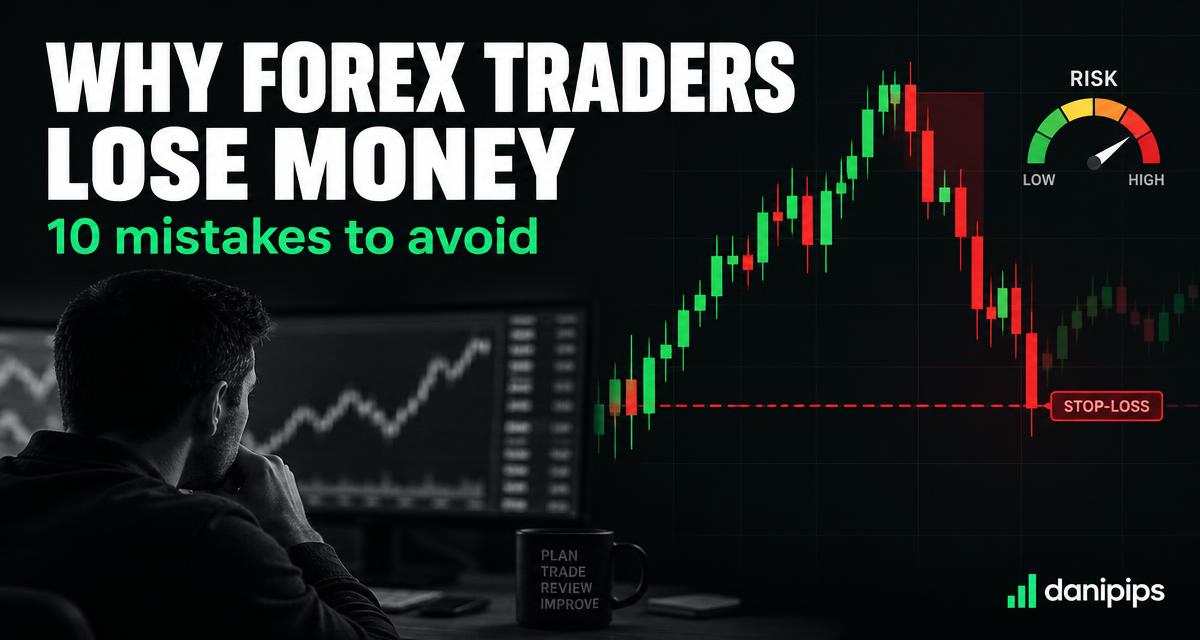
Why do forex traders lose money even when they can identify a trend? Often, the problem is not a missing indicator. It is the combination of oversized positions, unplanned exits, trading costs and emotional decisions. A good market idea can still produce a poor result when the risk behind it is too large.
This beginner guide explains ten common forex trading mistakes, with practical examples and a checklist you can use before your next demo trade. It applies to currency pairs such as EURUSD and GBPUSD, as well as leveraged gold trading on XAUUSD. It does not promise profitable trading: losses remain possible even with careful preparation.
The short answer: risk mistakes turn normal losses into serious damage
A losing trade is not automatically a mistake. Price is uncertain, and a reasonable setup can fail. The real warning sign is when one loss is much larger than planned, or when a series of trades ignores your own rules.
Separate strategy results from execution quality. Ask both: “Did the setup work?” and “Did I follow my risk plan?” You can learn from a planned loss. An uncontrolled loss makes that learning much more expensive.
1. Choosing lot size before deciding the stop-loss
Some beginners choose 0.10 lots because the profit looks attractive, then search for a stop-loss that fits the account. This reverses the process. Decide where the trade idea becomes invalid, measure the stop distance, and only then calculate an affordable position size.
Example: You have a $500 USD account and choose an illustrative risk budget of 1%, or $5. On EURUSD, a 25-pip stop with a typical pip value of $10 per pip for one standard lot gives:
Lot size = $5 ÷ (25 pips × $10) = 0.02 lots.
At 0.02 lots, the approximate pip value is $0.20; a 25-pip adverse move is roughly $5 before commissions and slippage. At 0.10 lots, the same move is about $25, or 5% of the account. Check the instrument specification and account currency: pip values and contract sizes are not identical across products.
The 1% figure is an educational example, not a universal safe rule. If broker minimum trade sizes make your planned risk impossible, skip the trade or continue on demo rather than forcing it. Learn more in Pips, Lots and Position Sizing.
2. Confusing available leverage with an affordable risk level
Leverage reduces the margin required to control a position. It does not make the price movement smaller or protect your balance. A platform allowing a large trade is not evidence that the trade fits your account.
Suppose two traders hold the same EURUSD position size but use different leverage settings. The profit or loss from a given price movement is broadly the same before costs; the margin requirement differs. The danger appears when lower margin encourages a larger position or too many simultaneous trades.
Check position size, used margin, free margin and the account’s stop-out rules together. Do not treat spare margin as spare money to lose. Read Forex Margin Explained.
3. Moving a stop-loss farther away to avoid accepting a loss
You enter a buy trade because support should hold. When price breaks support, you move the stop lower and tell yourself the market will return. Your original risk limit has disappeared, and the trade is now a different decision.
If a trade planned to risk $5 becomes a $15 loss, one emotional adjustment has tripled the downside. A later recovery does not make this habit safe; it may simply reinforce it until a larger move occurs.
Write the invalidation level before entry. If you cannot accept the potential loss, reduce the position or do not enter. Stop orders can execute worse than the requested level during gaps or fast markets; check your platform’s order handling. A stop-loss is a risk-management tool, not a guarantee of a precise maximum loss.
4. Revenge trading after a losing position
Revenge trading means placing the next trade mainly to recover the last loss. Common signs include doubling lot size, entering without a setup, or switching to a faster timeframe because the market feels too slow.
For example, after losing $5, a trader risks $15 on an unplanned GBPUSD entry. Another loss now leaves them $20 down instead of $5. The urge to recover becomes stronger, even though their decisions are becoming weaker.
Create a pause rule while you are calm. One possible practice rule is to stop for the session after two planned losses and review the screenshots. This is a training example, not a guarantee or a rule that fits everyone. Never increase risk just because you feel the market owes you a recovery. See Trading Psychology for Beginners.
5. Trading too often and ignoring costs
Every click is not an opportunity. When you trade out of boredom, weak setups multiply while spreads, commissions and possible overnight financing reduce the result.
Consider ten round-trip trades that each cost an illustrative $0.60 in combined transaction costs. That is $6 spent even if the price-based results approximately cancel out. On a $100 account, this is meaningful. Actual costs depend on the account, instrument, position size and market conditions.
Track results after costs, not only the green or red number shown immediately after entry. Limit yourself to a defined setup rather than a target number of trades. Understand Why Forex Trades Start Negative.
6. Entering just before news without a plan
A quiet chart can change rapidly when inflation data, employment numbers or an interest-rate decision arrives. EURUSD and gold may move sharply in either direction, spreads can widen, and execution may differ from what you expected.
A trader buying XAUUSD minutes before a major US release may discover that a stop distance based on the earlier calm period is unsuitable for the new volatility. Guessing the headline correctly does not guarantee the price reaction: expectations and accompanying details matter too.
Check the economic calendar and confirm event times in your local timezone. If you have not tested a news-trading process, sitting out the release is a reasonable choice. Do not assume a visible pending order will execute at exactly the displayed price.
7. Stacking trades that share the same underlying risk
Three open trades do not necessarily create diversification. Buying EURUSD and GBPUSD together can give you similar exposure to a weakening US dollar. Adding gold may introduce further dollar-sensitive risk, although correlations change and are never fixed.
If each position has a planned $5 risk, your total planned downside is $15, not $5. A single dollar-related event could affect all three at once. Slippage may increase the actual loss beyond that estimate.
Review the account as a whole before opening another position. Ask what happens if the next major event moves against every trade. Record total open risk and avoid assuming that different symbols always behave independently.
8. Copying signals without understanding the trade
A screenshot showing a winning position does not reveal the losing trades, the account size, the entry delay or the risk taken. A signal may also reach you after the original price has moved, changing the stop distance and reward potential.
Before following any idea, identify the entry logic, invalidation level, position size and conditions for staying out. If these are missing, you do not have a complete plan. Be especially cautious about guaranteed-return claims, pressure to deposit quickly and requests to send money to a private individual.
Check a broker’s relevant legal entity and authorization through official sources for your jurisdiction. The CFTC’s forex fraud advisory describes warning signs; its registration guidance is US-specific, so traders elsewhere should use their own regulator’s records too.
9. Switching strategies after every short losing streak
Changing indicators after two losses makes it difficult to know whether the method is weak or whether you simply experienced normal uncertainty. Each new strategy starts a new learning process, often without enough records to compare it fairly.
Choose one clearly defined setup for a structured demo practice period. Record qualifying trades, including the ones that lose, and review the same entry and exit rules consistently. A small sample can be misleading; there is no magic trade count that proves a strategy will work in the future.
Measure average win, average loss, trading costs, drawdown and rule-following—not win rate alone. A method with frequent small wins can still lose overall if occasional losses are much larger. Risk–Reward Ratio and Break-Even Win Rate explains the arithmetic.
10. Trading without a journal or an affordable budget
If the money is needed for rent, school fees or emergencies, normal market fluctuations can create pressure to make desperate decisions. Forex should not be treated as a reliable salary or a solution to urgent bills.
Keep essential funds separate. Then maintain a simple journal with the date, instrument, setup, entry, stop, position size, planned risk, costs and final outcome. Add one sentence about whether you followed the rules. A screenshot before entry and after exit makes reviews more concrete.
Your weekly review should identify repeatable problems: oversized positions, entries outside your session, unnecessary news exposure or exits driven by fear. Use the Forex Trading Plan Template to turn those observations into written rules.
A five-day demo reset for beginners
- Day 1: Write one setup and its invalidation conditions. Choose an affordable practice risk budget and a stopping rule.
- Day 2: Practise position-size calculations before placing any orders. Check contract specifications rather than guessing.
- Day 3: Take only qualifying demo setups. Skipping the day is acceptable when none appear.
- Day 4: Review transaction costs, total open exposure and whether news affected execution.
- Day 5: Compare planned risk with actual outcomes. Choose one process mistake to work on next week.
Five days will not prove profitability. This exercise is about replacing impulsive actions with observable habits. Demo execution and emotions may differ from live trading.
Pre-trade checklist: seven questions before you click
- Can I explain the setup in one sentence?
- Where is the trade idea invalidated?
- Does my lot size fit that stop distance and my planned risk?
- Have I included costs and allowed for possible slippage?
- Is a major news release approaching?
- What is my total risk across all open positions?
- Am I following a plan, or trying to recover a loss?
If you cannot answer one of these questions, pause. Missing a trade is usually easier to review than taking a position you never understood.
Frequently asked questions
Can forex traders lose money with a high win rate?
Yes. Eight wins of $2 produce $16, but two losses of $10 produce a $20 loss. The net result is minus $4 before additional costs, despite an 80% win rate. Average win size, average loss size and costs all matter.
Does a higher leverage setting automatically mean a larger loss?
Not for an unchanged position size and the same price movement. Higher available leverage changes margin requirements and may make it easier to take excessive exposure. The position you actually open is what matters for price-based profit and loss.
Is demo trading risk-free?
A demo account normally uses virtual funds, so its trading losses do not directly reduce real trading capital. However, unrealistic practice can teach bad habits, and demo results do not guarantee live results. Treat the virtual balance as a training environment, not proof that you are ready to trade large amounts.
How can I practise these rules before using real money?
Follow the free Exness demo-account guide. If Exness is available and appropriate in your country, you can also open an Exness account through Danipips and explore demo practice. Check the legal entity, local eligibility and terms before proceeding; features can vary.
Referral disclosure: This is a Danipips referral link. Danipips may receive compensation from eligible activity through it. A referral does not make trading safer or guarantee results.
The takeaway
You cannot remove uncertainty from forex. You can make your decisions easier to measure: size the position from the stop distance, control total exposure, account for costs, pause after emotional losses and review a journal. The goal is not to avoid every losing trade. It is to stop ordinary losses from becoming uncontrolled account damage.
Further reading: The CFTC’s OTC forex customer advisory explains dealer and leverage risks, while its forex fraud guidance covers misleading promotions. These resources discuss US regulatory conditions; check the rules that apply where you live.
Risk warning: This article is educational, not personalized financial advice. Leveraged forex and CFD trading can cause substantial losses. Stops may slip, past results do not guarantee future performance, and you should never trade money needed for essential expenses.